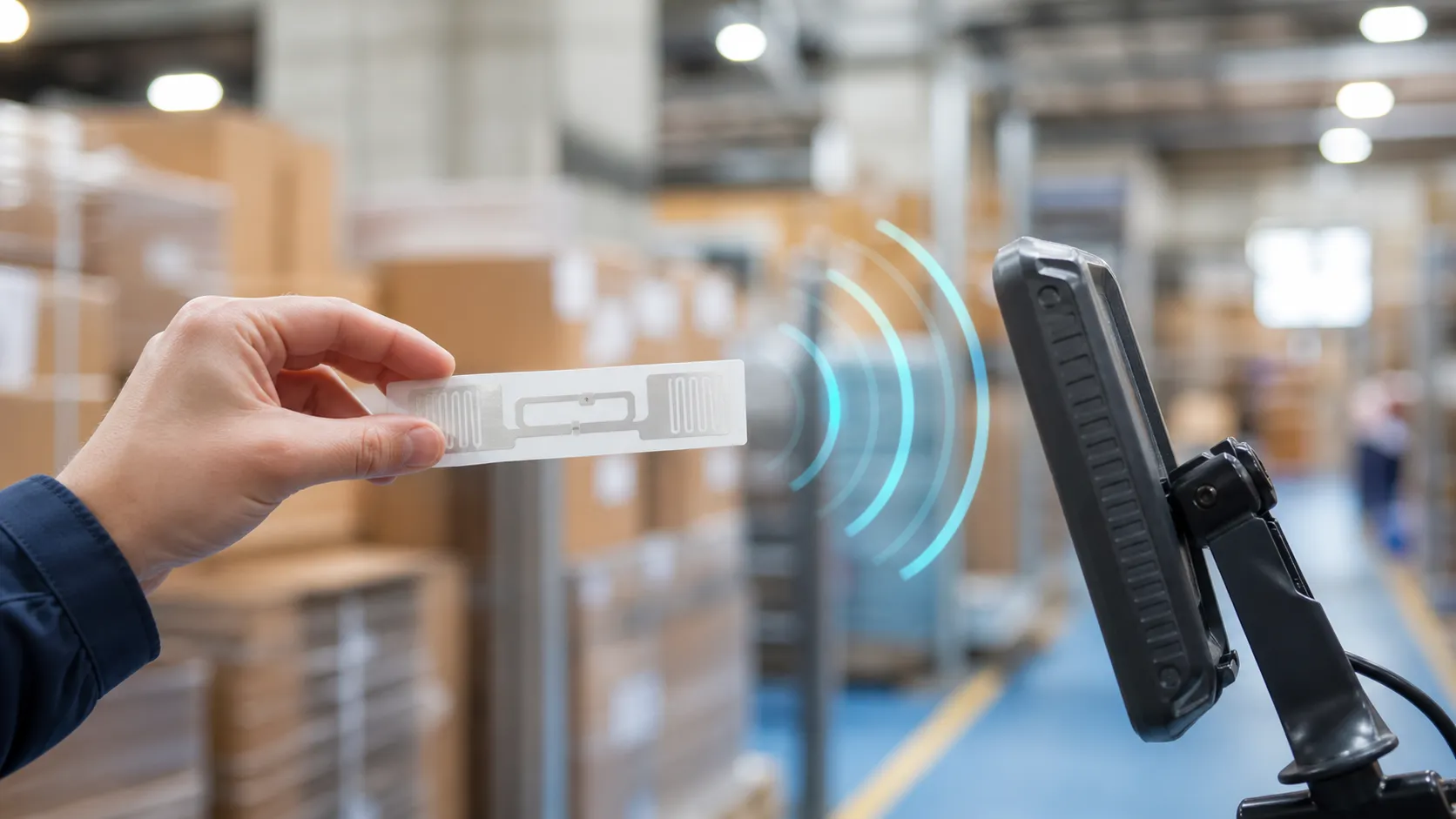
Passive uhf rfid tag range is the farthest distance a batteryless rfid inlay returns EPC data—not merely where the activation signal still reaches the tag.
In scope: UHF read distance on handheld rfid reader sweeps vs fixed reader portals, plus performance benchmarks for passive uhf rfid tags in warehouses.
Out of scope: Treating active rfid vs passive rfid beacon range as interchangeable without checking operating frequency (low frequency lf / HF vs UHF).
Typical RAIN RFID deployments span 3–15 m; long range rfid with high gain antenna or metal tag designs can exceed 30 ft when the reflected signal stays above reader sensitivity.
Passive UHF RFID Tag Range: Distance Limits & Technology Comparison
Under optimal line-of-sight, average passive uhf rfid tag range spans 3 to 15 meters (10 to 50 feet). Batteryless tags harvest the reader activation signal, then backscatter a reflected signal carrying stored EPC data[1].
Average Read Distance for Passive UHF RFID Tags
In typical deployment environments, real-world passive UHF RFID read distance varies based on form factor and reader setup:
- Standard RFID Inlays: Achieve 5 to 10 meters (16 to 33 feet) of reliable coverage.
- High-Gain Specialized Tags: Reach 12 to 15+ meters (40 to 50+ feet) in open space.
- Compact or On-Metal Tags: Deliver 1 to 4 meters (3 to 13 feet) due to space and surface constraints.
Active RFID vs Passive RFID vs HF/LF Read Distance
Choosing the right technology depends on your required distance, frequency, and budget:
| RFID Technology | Operating Frequency | Typical Read Distance | Primary Use Case |
|---|---|---|---|
| Low frequency LF | 125 – 134.2 kHz | Short range (< 10 cm / 4 in) | Access control, animal tracking |
| High Frequency (HF/NFC) | 13.56 MHz | Proximity range (< 1 meter / 3.3 ft) | Contactless payment, library tags |
| Passive UHF (RAIN RFID) | 860 – 960 MHz | Long range (3 to 15+ meters / 10 to 50+ ft) | Supply chain, asset tracking |
| Active RFID (see active rfid lines for battery beacons) | 433 MHz / 2.4 GHz | Extreme range (100+ meters / 300+ ft) | Vehicle tracking, real-time location |
Standard Operating Frequency Bands (860 MHz to 960 MHz)
Passive UHF RFID operates in the 860 MHz to 960 MHz operating frequency window—see uhf rfid tag frequency for regional sub-bands. Key allocations include:
- FCC Band (Americas): 902 MHz – 928 MHz (higher EIRP for maximum range)[2].
- ETSI Band (Europe): 865 MHz – 868 MHz.
- Broadband Global Inlays: Engineered across the entire 860–960 MHz range to guarantee uniform read performance across global supply chains.
Key Factors Affecting Passive UHF RFID Tag Range
Core variables—reader EIRP, high gain antenna geometry, rfid inlay sensitivity, and material detuning—set whether a lane reads at 5 ft or 40 ft. Phased array fixed reader heads can steer beams for choke-point coverage; handheld rfid reader setups trade peak distance for mobility.

Reader Power Output and High Gain Antenna Setup
- FCC Power Limits: In North America, regulations cap reader transmit power at 4 Watts EIRP (Equivalent Isotropically Radiated Power)[2]. Maxing out allowable power increases the activation signal reaching the tag.
- High gain antenna usage: Concentrates RF into a focused beam for longer read distance—pair with uhf rfid tag antenna gain planning on portal layouts.
Tag Antenna Size and IC Chip Sensitivity
- Physical Antenna Size: Larger RFID inlay surface areas capture more RF energy, yielding significantly longer read ranges than compact, discreet tags.
- Tag Sensitivity (dBm): Integrated circuit (IC) sensitivity measures how much power a chip needs to wake up. A chip rated at -24 dBm is far more sensitive than an older -18 dBm chip, allowing it to activate at much greater distances using less power.
Environmental Interference: Metal and Liquids
RF energy in the 860-960 MHz band interacts poorly with dense or conductive materials:
- Liquids: Water and liquid-filled products absorb RF energy, causing severe RFID signal attenuation.
- Metals: Standard tags placed directly on metal suffer from detuning, reflecting the signal away and collapsing the read range to zero.
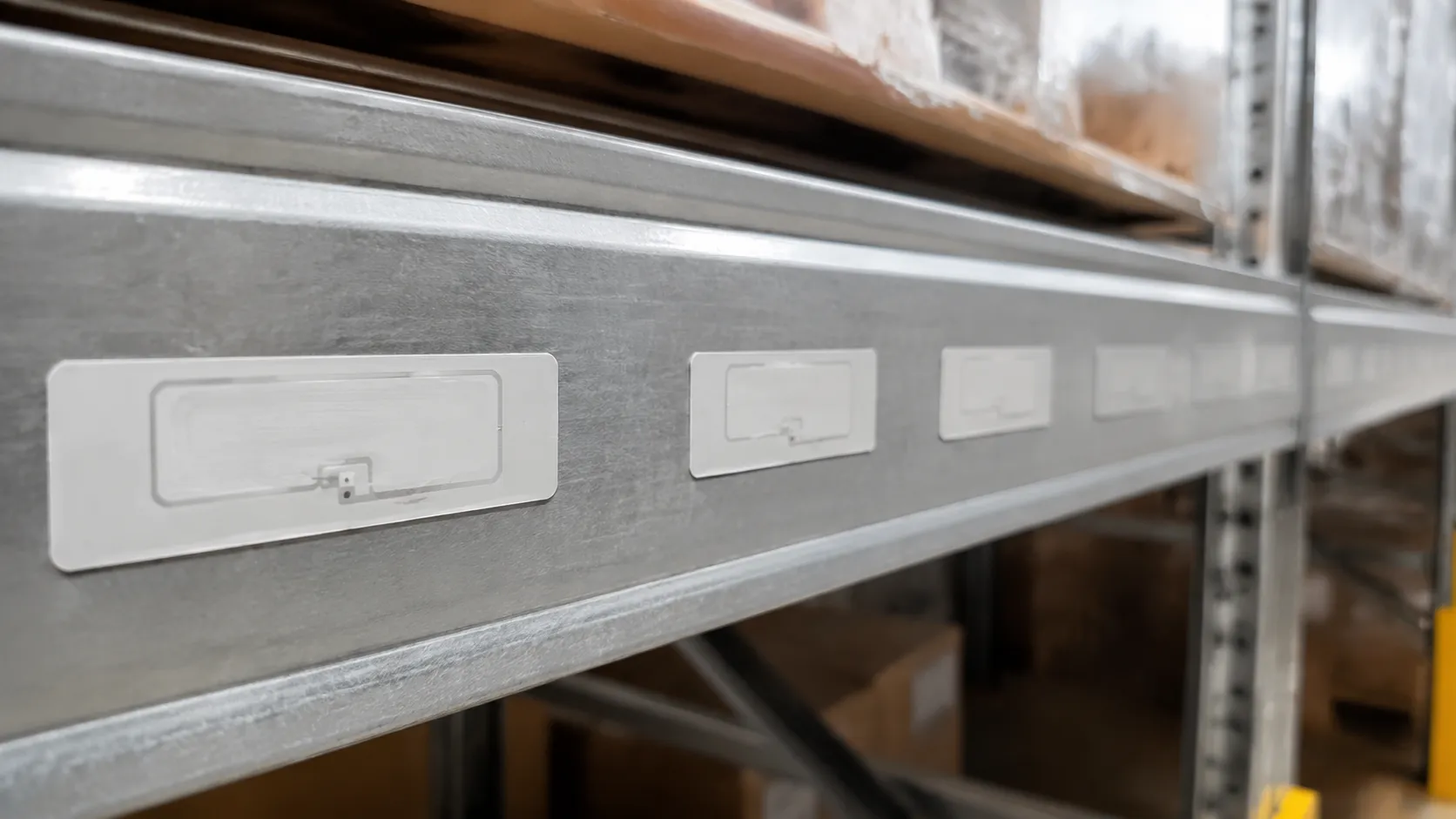
- Fix: Use specialized metal tag / on-metal inlays with isolation layers to restore read distance on steel assets.
Antenna Polarization: Circular vs Linear
| Polarization Type | Read Distance Capability | Primary Application |
|---|---|---|
| Linear Polarization | Longest Range (Focused, single-plane beam) | Fixed portals and choke points where tag orientation is strictly controlled. |
| Circular Polarization | Moderate Range (Broader, rotating beam) | Handheld RFID readers and dynamic warehouse environments where tags enter from various angles. |
Tag Orientation Relative to Reader Antenna
- Face-to-Face (Optimal): Tags oriented parallel to the reader antenna absorb maximum energy, achieving the maximum rated passive UHF RFID tag range.
- Perpendicular (Sub-Optimal): Tags presented edge-on to the antenna struggle to capture RF energy, shrinking the effective read zone down to a fraction of its potential.
How to Maximize Passive UHF RFID Read Range
Maximizing passive uhf rfid tag range aligns tag form factor, reader power, and placement. Catalog passive uhf rfid tag lines cover standard inlays; on-metal SKUs extend range on difficult surfaces.

Selecting Tag Antenna Designs and Form Factors
Tag geometry directly dictates how much power the chip receives from the reader's signal.
- Match Inlay Size to Available Space: Larger RFID inlay designs catch more RF energy, which increases overall passive UHF RFID read distance.
- Prioritize High IC Sensitivity: Modern chips require lower turn-on power, allowing them to send back a strong reflected signal even from distant readers.
- Select Orientation-Agnostic Geometries: Dual-dipole tag antennas ensure reliable reads regardless of whether assets pass by horizontally or vertically.
Using Specialized On-Metal and Liquid-Safe RFID Tags
Metals bounce RF energy away, while liquids absorb it—both causing severe RFID signal attenuation. Standard labels fail quickly on these surfaces.
| Tag Category | Target Surface | Range Optimization Benefit |
|---|---|---|
| Standard Inlay | Cardboard boxes, plastics, dry goods | Delivers baseline maximum range on non-interfering materials |
| On-Metal RFID Tags | Steel beams, tools, metal containers | Integrates an insulating spacer to prevent metal detuning |
| Flag Tags & Standoffs | Liquid bottles, chemical drums | Extends the antenna away from fluid to eliminate signal absorption |
Optimizing Reader Power Settings and Antenna Placement
Strategic reader setup allows you to push read zone boundaries while staying fully compliant with US FCC regulations.
- Tune EIRP to Legal Limits: Set your RFID reader power output EIRP to the highest permissible level (4W EIRP in North America) to push maximum energy into the field.
- Use High Gain Antennas: Upgrading a fixed reader with a high gain antenna narrows the RF beam, projecting coverage much deeper down warehouse aisles.
- Select the Right Antenna Polarization: Choose linear antennas for maximum distance when tag orientation is predictable. Use circular polarization when tagged assets pass through choke points at random angles.
Minimizing Electromagnetic Interference and Signal Absorption
Background RF noise degrades UHF RFID tag antenna gain and shrinks your actual tracking area.
- Clear Physical Path Obstructions: Eliminate dense obstacles between the reader face and passing assets to preserve line-of-sight signal propagation.
- Isolate High-Noise Equipment: Mount reader antennas away from large electric motors, Wi-Fi access points, and unshielded machinery.
- Configure RAIN RFID reader profiles: Use dense-reader mode, channel hopping, and Gen2 anti collision session settings within 902–928 MHz[3].
Real-World Passive UHF RFID Tag Range Benchmarks
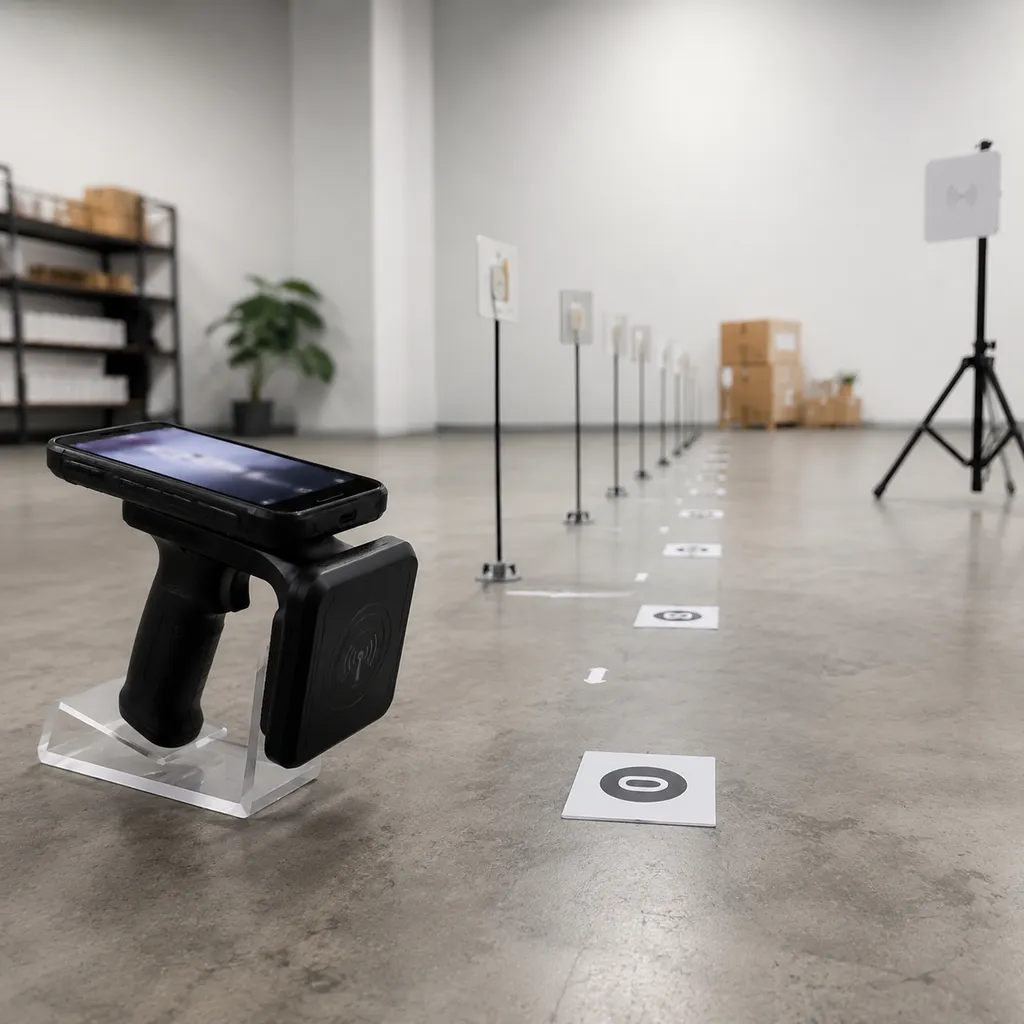
Performance benchmarks for passive uhf rfid tags vary by reader class and environment—sample ranges below reflect field deployments, not datasheet maxima alone.
Supply Chain and Warehouse Asset Tracking
In large distribution centers, clear line-of-sight and high-power antennas deliver maximum distance for tracking pallets, cases, and racking assets.
- Fixed Portal Readers: 20 to 35 feet when passing through dock doors equipped with overhead antennas.
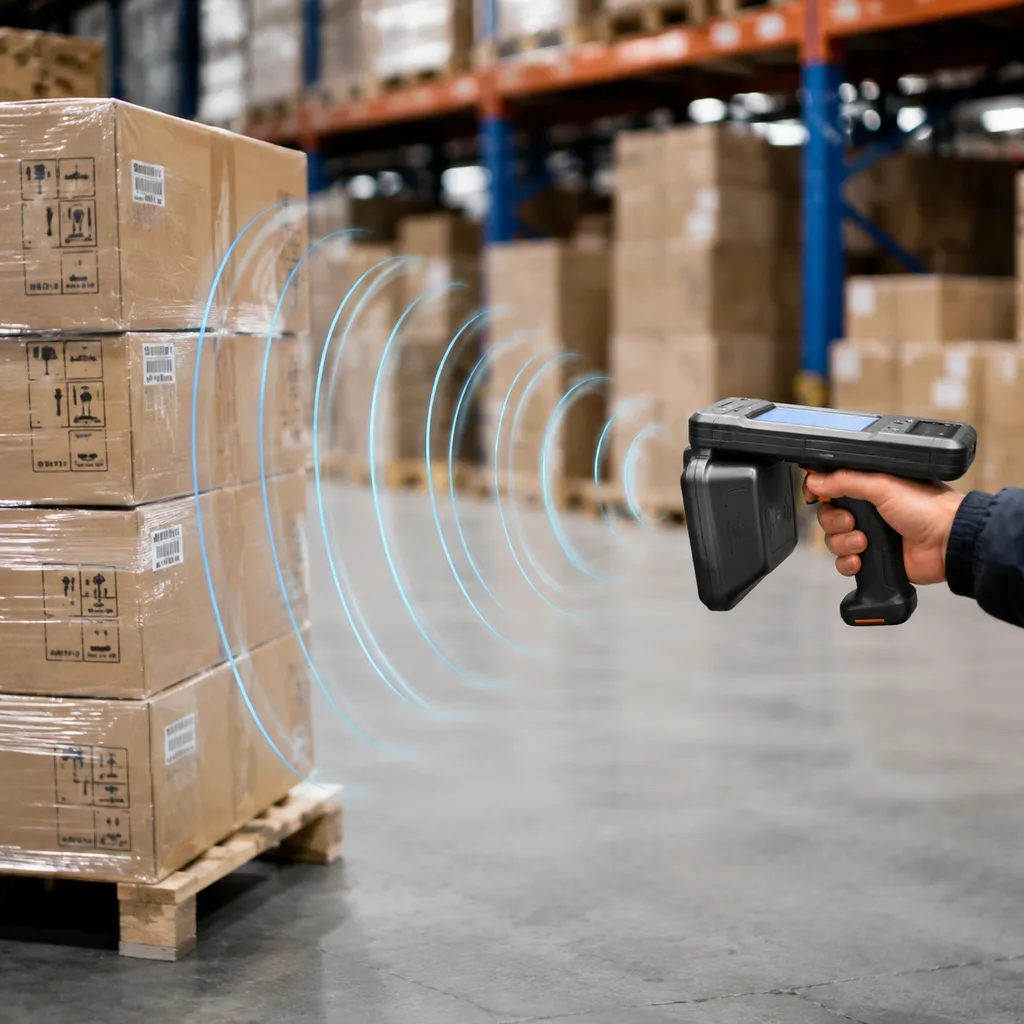
- Handheld RFID Readers: 10 to 20 feet during manual aisle sweeps and inventory counts.
- Forklift Systems: 10 to 15 feet for real-time pallet identification during transit.
For high-density metal rack environments, using specialized on-metal RFID tags maintains a reliable UHF RFID asset tracking range without signal dropouts.
Retail Inventory and Item-Level Tagging
Retail environments prioritize fast, multi-tag reads over extreme distance. Standard RFID inlay designs on apparel tags or sticker labels operate at precise power levels to avoid accidental cross-reads from adjacent shelves.
| Application | Reader Setup | Expected Read Distance |
|---|---|---|
| Store Floor Sweeps | Handheld RFID reader | 5 – 12 feet |
| Fitting Room & POS | Integrated desk / overhead antenna | 3 – 6 feet |
| Stockroom Inventory | Overhead RAIN RFID ceiling arrays | 10 – 18 feet |
Vehicle Tracking and Automated Access Control
Automated gate access and parking systems require long range RFID performance at higher speeds. Windshield tags and bumper mounts maximize signal reflection off moving vehicles.
- Windshield Tags: 25 to 40 feet when approaching a gated entry paired with a high-gain fixed reader.
- License Plate Tags: 20 to 30 feet using ruggedized, exterior-rated tags.
- Speed Limits: Vehicles moving up to 25 mph consistently trigger access gates within these benchmark distances.
Frequently Asked Questions About Passive UHF RFID Range
Maximum Read Range for Passive UHF RFID Tags
In real-world industrial environments, standard passive UHF RFID tags deliver a practical passive UHF RFID read distance of 15 to 25 feet (4.5 to 7.5 meters). Under ideal line-of-sight conditions using high-gain reader antennas and specialized long-range tags, maximum read distances can reach 30 to 45 feet (9 to 13.7 meters). High-sensitivity inlays optimize peak read distance across standard readers.
Why Metal and Water Interfere with Signal Distance
Passive UHF RFID operates in the 860-960 MHz frequency band, which is uniquely sensitive to environmental materials:
- Metal surfaces: Reflect radio waves, detuning the tag antenna and causing destructive signal cancellation.
- Water and liquids: Absorb UHF RF energy, preventing the activation signal from energizing the chip.
To overcome attenuation, on-metal inlays with isolation spacers maintain read distance on metal assets and fluid containers.
Impact of Antenna Polarization on Read Distance
Antenna polarization directly impacts how far and how reliably your reader picks up tag signals:
| Polarization Type | Read Distance | Key Advantage | Best Use Case |
|---|---|---|---|
| Linear Polarization | Longest (concentrated beam) | Maximize distance in a single orientation | Choke points, conveyor lines, and vehicle gates |
| Circular Polarization | Moderate (~30% shorter range) | Reads tags at any angle or orientation | Handheld scanners, retail shelves, and bulk inventory |
Extending RFID Range Without Replacing Hardware
You can significantly optimize your RFID read zone and gain extra distance using your existing setup:
- Increase Reader Output: Turn up reader transmit power (EIRP) to the maximum permitted regulatory limit.
- Optimize Antenna Placement: Angle reader antennas directly toward tag motion paths to ensure clear line-of-sight.
- Adjust software settings: Fine-tune Gen2 anti collision sessions to prioritize sensitivity over high-speed polling.
- Reduce RF Noise: Move clear of nearby metal obstructions and high-power wireless devices that cause signal interference.